This blog is from the National Institute of General Medical Sciences, one of the National Institutes of Health in the U.S. Department of Health and Human Services. By supporting basic biomedical research and training nationwide, NIGMS lays the foundation for advances in disease diagnosis, treatment, and prevention.

Biomedical Beat highlights NIGMS-funded research and scientists, as well as images and tools that help illustrate biomedical concepts and advances to the general public. Our Educator's Corner is a free resource is designed for educators to build on the existing NIH STEM content, like topics from our Pathways magazines and other basic science areas, through the integration of supplemental material in Biomedical Beat blog posts.

We encourage you to share the articles.

Career Conversations: Q&A With Biologist Akhila Rajan

November 3, 2021
A headshot of Dr. Akhila Rajan. Dr. Akhila Rajan. Credit: Fred Hutchinson Cancer Research Center.
“What makes being a scientist exciting is that I don’t know what I’m going to find tomorrow,” says Akhila Rajan, Ph.D., an assistant professor in the basic sciences division at Fred Hutchinson Cancer Research Center in Seattle, Washington. Dr. Rajan is supported by an NIGMS early stage investigator Maximizing Investigators’ Research Award. These awards provide stable and flexible funding for a program of research that falls within NIGMS’ mission. Check out the highlights of our interview with Dr. Rajan to learn about her research and journey as a scientist.

Continue Reading

It’s Elementary: Celebrating National Chemistry Week

October 20, 2021

Happy National Chemistry Week! In honor of this celebration, we’re showcasing posts that focus on elements crucial for human health and scientific exploration. NIGMS-supported scientists are studying how each of these elements (and many others) can impact human health. Check out the list below to learn more, and let us know what your favorite element is in the comments section!

A square showing helium’s abbreviation (He), atomic number (2), and atomic weight (4.003). Credit: Adapted from Compound Interest. CC BY-NC-ND 4.0.
Helium: An Abundant History and a Shortage Threatening Scientific Tools
Scientists first discovered helium burning on the surface of the sun. Today, liquid helium plays an essential role in supercooling vital scientific and medical equipment, such as magnetic resonance imaging machines that take images of our internal organs. Unfortunately, our complex history with the element has led to a recent shortage that threatens some types of scientific research.


Continue Reading

Pathways: The Anesthesia Issue

October 14, 2021
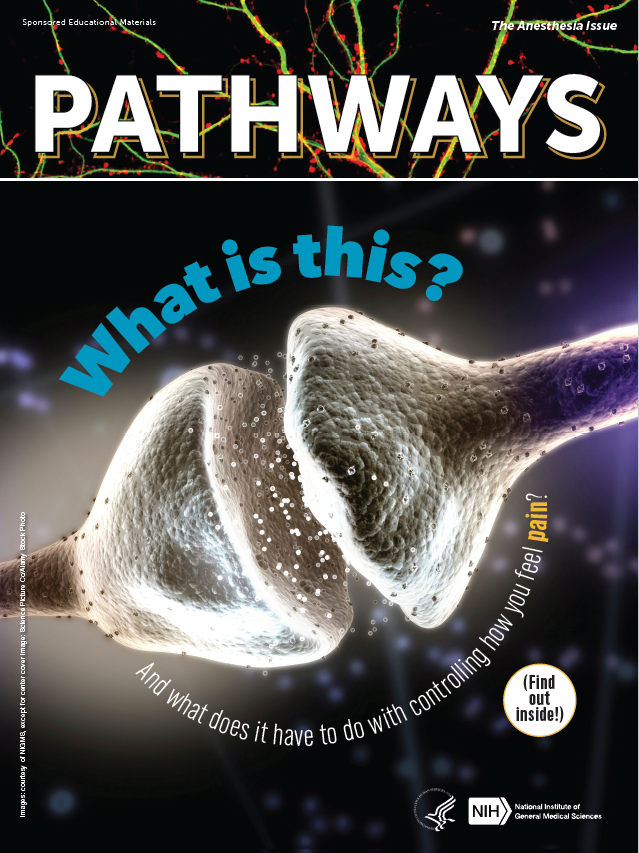
A magazine cover showing two mushroom-like structures with their wide ends facing each other and small particles between them. Text reads What is this? And what does it have to do with controlling how you feel pain? (Find out inside!). Cover of Pathways student magazine.

NIGMS and Scholastic bring you Pathways: The Anesthesia Issue, which explores pain and the science behind anesthesia—the medical treatment that prevents patients from feeling pain during surgery and other procedures. Without anesthesia, many life-saving medical procedures would be impossible.

Pathways, designed for students in grades 6 through 12, aims to build awareness of basic biomedical science and its importance to health, while inspiring careers in research. All materials in the collection are available online and are free for parents, educators, and students nationwide.

Continue Reading

Could a Spoonful of Sugar Be a Medicine?

September 29, 2021
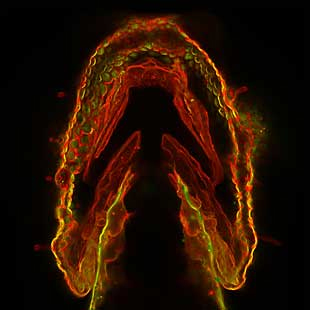
A spade-shaped group of cells glowing red, yellow, and green.
Glycans glow red, yellow, and green in this image of a zebrafish embryo's jaw. Credit: Carolyn Bertozzi, University of California, Berkeley.

Large sugar molecules called glycans coat every cell in our bodies. They can also be found inside and between cells, and they are important for many biological processes, including how our cells interact with one another and with pathogens. For example, glycans on red blood cells determine blood type, and those on the cells of organs determine whether a person can receive a transplant from a particular donor. Scientists have only begun to explore sugars’ complexities and potential uses. Here, we look at the contributions three NIGMS-supported researchers are making to glycoscience.

Human Milk Sugars

Glycans called human milk oligosaccharides (HMOs) make up a significant portion of human milk. Study findings have shown that some HMOs can be prebiotics—substances that encourage beneficial bacteria to grow. Research has also revealed that some disease-causing microbes bind to certain HMOs, potentially allowing the germs to pass through the body without causing illness.

Continue Reading

Dairy Deconstructor: How an Enzyme Enables Milk Digestion

June 2, 2021

Did you know that the lack of a single enzyme is responsible for lactose intolerance, a common condition that causes people to have trouble digesting milk? Fortunately, the enzyme is available in an over-the-counter pill for lactose-intolerant people who want to enjoy dairy products. Enzymes are molecules—almost always proteins—that speed up chemical reactions by reducing the amount of energy needed for the reactions to proceed. Without them, many processes in our bodies would essentially grind to a halt.

Continue Reading