This blog is from the National Institute of General Medical Sciences, one of the National Institutes of Health in the U.S. Department of Health and Human Services. By supporting basic biomedical research and training nationwide, NIGMS lays the foundation for advances in disease diagnosis, treatment, and prevention.

Biomedical Beat highlights NIGMS-funded research and scientists, as well as images and tools that help illustrate biomedical concepts and advances to the general public. Our Educator's Corner is a free resource is designed for educators to build on the existing NIH STEM content, like topics from our Pathways magazines and other basic science areas, through the integration of supplemental material in Biomedical Beat blog posts.

We encourage you to share the articles.
Public Alerted to Omicron in New Mexico Through Quick Detection

June 1, 2022
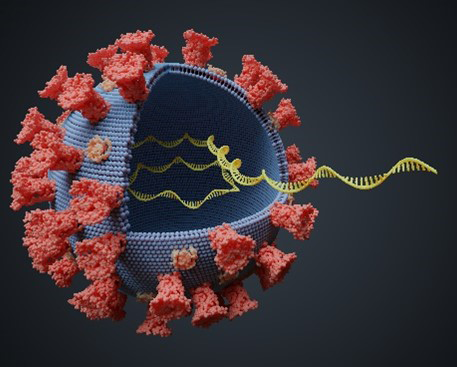
A sphere with spikes on the outside cut open to reveal a long strand.
Genetic material inside a virus. Credit: iStock.

Over the past 2 years, you’ve probably heard a lot about the spread of SARS-CoV-2—the virus that causes COVID-19—and the emergence of variants. The discovery and tracking of these variants is possible thanks to genomic surveillance, a technique that involves sequencing and analyzing the genomes of SARS-CoV-2 virus particles from many COVID-19 patients. Genomic surveillance has not only shed light on how SARS-CoV-2 has evolved and spread, but it has also helped public health officials decide when to introduce measures to help protect people.

In December 2021, the NIGMS-supported SARS-CoV-2 genomic surveillance program at the University of New Mexico Health Science Center (UNM HSC) in Albuquerque detected the first known case of the Omicron variant in the state, which enabled a rapid public health response. The program’s co-leaders, assistant professors Darrell Dinwiddie, Ph.D., and Daryl Domman, Ph.D., were watching on high alert for it to enter New Mexico, and when it did, they were poised to quickly identify it:

Continue Reading

In Other Words: Translation Isn’t Only for Languages

August 4, 2021

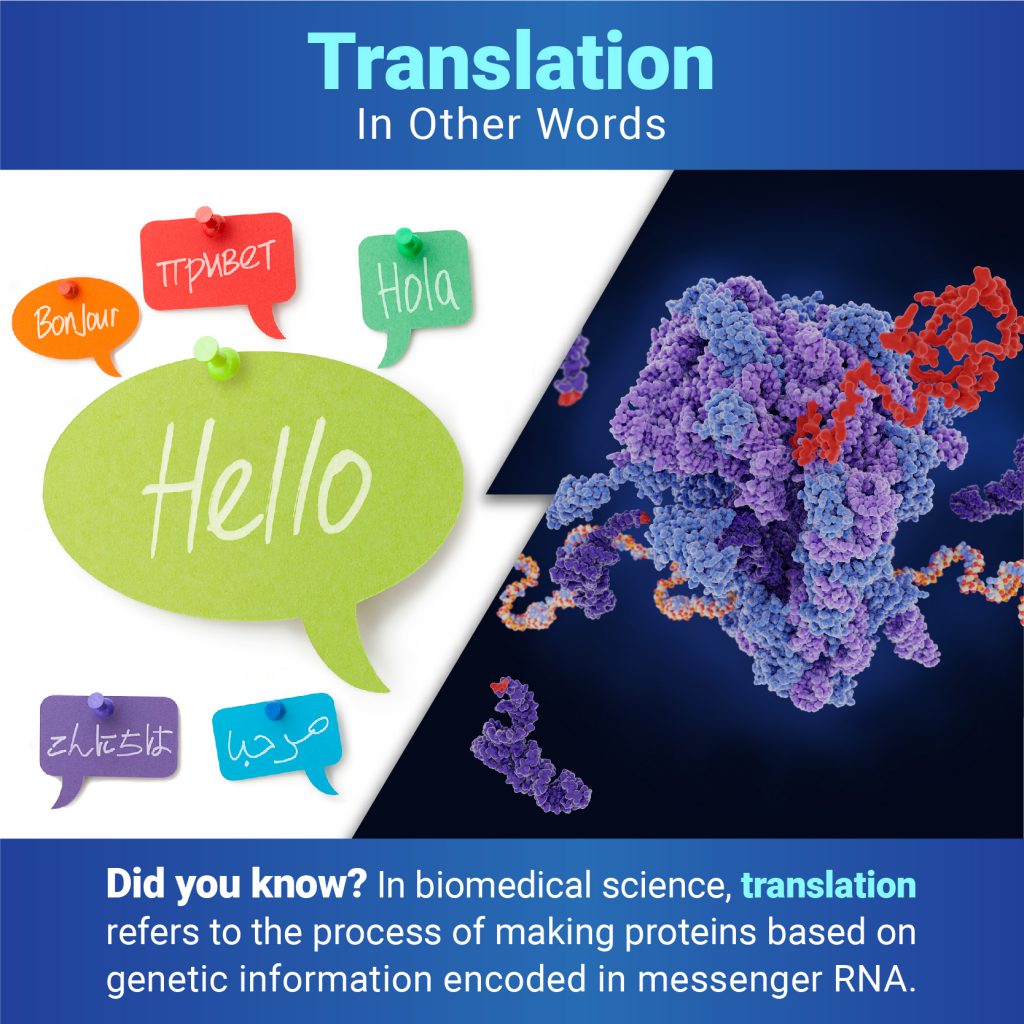
In everyday use, most people understand translation to mean converting words from one language to another. But when biologists talk about translation, they mean the process of making proteins based on the genetic information encoded in messenger RNA (mRNA). Proteins are essential for virtually every process in our bodies, from transporting oxygen to defending against infection, so translation is vital for keeping us alive and healthy.

Below the title “Translation: In Other Words,” two images are separated by a jagged line. On the left, is a large speech bubble with the word “hello” surrounded by smaller speech bubbles with greetings in other languages, and on the right is a ribosome producing a protein. Under the images, text reads, “Did you know? In biomedical science, translation refers to the process of making proteins based on genetic information encoded in messenger RNA.”
Credit: NIGMS.
Continue Reading

Quiz: Are You a Genetics Genius?

May 19, 2021

Genes are segments of DNA. They contain instructions for building one or more molecules that help the body work. Researchers in the field of genetics study genes and heredity—how certain traits are passed from parents to their offspring through DNA. NIGMS supports many scientists who investigate the genetics of people and research organisms to better understand human health and disease.

Take our quiz below to test how much you know about genetics. For more quizzes and other fun learning tools, visit our activities and multimedia webpage.

Continue Reading