NIH is moving the launch of its new website to the fall to ensure the best possible experience for everyone who relies on our websites for health information, research, funding opportunities, and other resources.
Throughout 2022, we shared the stories of dozens of NIGMS-supported researchers, trainees, and programs. We also highlighted new STEM education resources, tested your knowledge with quizzes, showcased extraordinary scientific images, and more. To celebrate the upcoming new year, we’re highlighting five of our most popular posts from 2022.
When asked why he leads the NIGMS-supported Science Education Partnership Award (SEPA) program at Dartmouth College in Hanover, New Hampshire, Roger D. Sloboda, Ph.D., the Ira Allen Eastman Professor of Biological Sciences (emeritus), shares a story. Several years ago, he learned of a public-school science teacher in rural New Hampshire who had a very limited budget for classroom equipment. With her annual budget, she’d been able to buy a single stainless-steel laboratory cart. “Next year, I hope to buy a piece of equipment to put on it,” she said. A short time later, Dr. Sloboda attended a scientific meeting and talked to a student from a private school in Washington, D.C., who was presenting a poster about his research project studying the effects of household chemicals on zebrafish development. Dr. Sloboda asked the student how he was able to work with zebrafish, because they require specialized, expensive facilities. The student responded that his school maintained its own zebrafish facility.
We’ve created a free resource for science educators! The Educator’s Corner is a collection of carefully curated Biomedical Beat posts, designed to align with existing NIGMS science education resources, such as Pathways, for middle and high school students. Our new collection offers educators additional tools and ideas to enhance lesson plans, building upon existing science education material that’s already available at no cost.
In the Educator’s Corner, you’ll find blog posts organized by the NIGMS science education resource they align with. Each entry includes a suggested activity for use in classrooms, home schools, and other appropriate settings. Student exercises range from pair-and-shares to simple demonstrations, freewrites, and more.
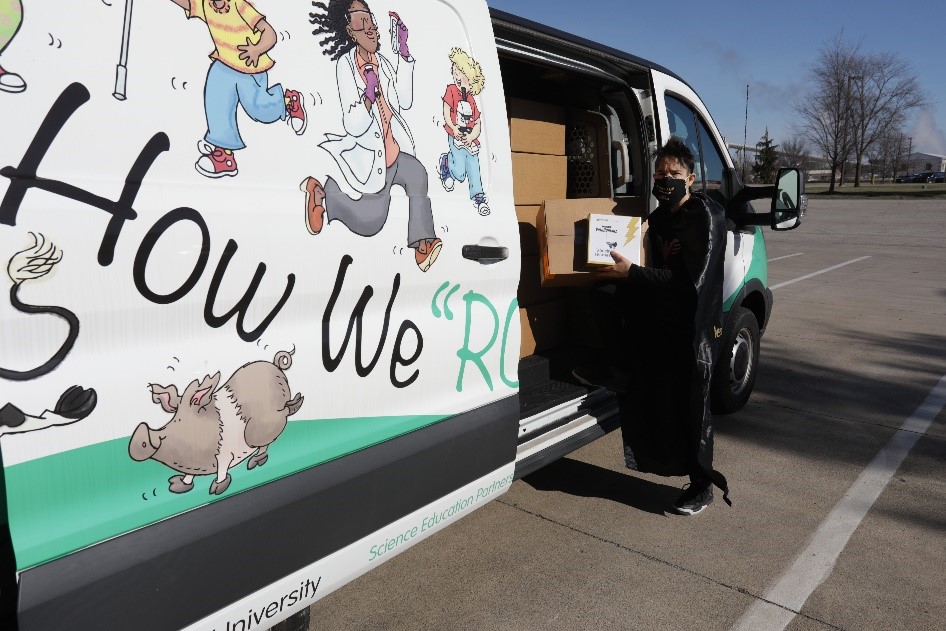
Pink Phoenix, alter ego of Dr. Sandra San Miguel, preparing to pass out Vaccine SuperPower Packs described later in this post. Credit: Courtesy of Dr. Sandra San Miguel.
“I’m Pink Phoenix, leader of the Vetahumanz League of superheroes, and it’s the best job in the world.” The League of VetaHumanz is a superhero league for veterinarians, founded and led by Pink Phoenix, the alter ego of Sandra San Miguel, D.V.M., Ph.D. Through support from the NIGMS Science Education Partnership Award (SEPA) program, the league seeks to diversify the veterinary profession.
Members of the league work with elementary students across the country to give them a sense of belonging to the veterinary profession. “I’m most proud of bringing people together who share the mission and vision with all their heart,” Pink Phoenix remarks. “Nobody can just be a member of the league. You have to earn the cape.” The league has over 400 certified role models throughout the country who are either veterinarians—VetaHumanz—or veterinary school students—VetaHumanz in training.
Attention, educators! We’re announcing a new clearinghouse of free STEM education resources covering a wide range of health and biomedical research topics for students in grades K through 12. The STEM teaching resources website provides links to great content from various institutes and centers within NIH, as well as materials developed under the NIGMS Science Education Partnership Award program.
The resources are easy to navigate within the following subject areas:
 National Institute of