Emily Carlson

Email
no43_email@nih.gov
First Name
Emily
Last Name
Carlson
machine_name
emily-carlson

Archived: Happy Birthday, BioBeat

August 25, 2017

This month, our blog that highlights NIGMS-funded research turns four years old! For each candle, we thought we’d illuminate an aspect of the blog to offer you, our reader, an insider’s view.

Who are we?

Over the years, the editorial team has included onsite science writers, office interns, staff scientists and guest authors from universities. Kathryn, who’s a regular contributor, writes entirely from her home office. Chris, who has a Ph.D. in neuroscience and now manages the blog, used to do research in a lab. Alisa has worked in NIGMS’ Bethesda-based office the longest: 22 years! She and I remember when we first launched Biomedical Beat as an e-newsletter in 2005. You can read more about each of the writers on the contributors page and if you know someone who’s considering a career in science communications, tell them to drop us a line.

How do we come up with the stories?

We get our story ideas from a range of sources. For instance, newspaper articles about an experimental pest control strategy in Florida and California prompted us to write about NIGMS-funded studies exploring the basic science of the technique. A beautiful visual from a grantee’s institution inspired a short post on tissue regeneration research. And an ongoing conversation with NIGMS scientific staff about the important role of research organisms in biological studies sparked the idea for a playful profile of one such science superstar.

A big change in our storytelling has been shifting the focus from a single finding to broader progress in a lab or field. So instead of reporting on a study just published in a scientific journal, we may write about the scientist’s career path or showcase a collection of recent findings in that particular field. These approaches help us demonstrate that scientific understanding usually progresses through the slow and steady work undertaken by many labs.

What are our favorite posts?

I polled the writers on posts they liked, and the list is really long! Here are the top picks.

Four Ways Inheritance Is More Complex Than Mendel Knew
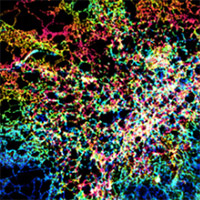

The Endoplasmic Reticulum: Networking in the Cell


Interview With a Scientist: Janet Iwasa, Molecular Animator


From Basic Research to Bioelectric Medicine
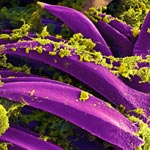

An Insider’s Look at Life: Magnified, an Airport Exhibit of Stunning Microscopy Images

What are your favorite posts?

We regularly review data about the number of times a blog post has been viewed to identify the ones that interest readers the most. That information also helps guide our decisions about other topics to feature on the blog. The Cool Image posts are among the most popular! Below are some other chart-topping posts.


Our Complicated Relationship With Viruses
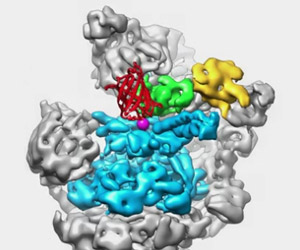

The Proteasome: The Cells Trash Processor in Action


Meet Sarkis Mazmanian and the Bacteria That Keep Us Healthy


5 Reasons Biologists Love Math

We always like hearing from readers! If there’s a basic biomedical research topic you’d like us to write about, or if you have feedback on a story or the blog in general, please leave your suggestions in the comment field below.

Continue Reading

Archived: Chasing Fireflies—and Better Cellular Imaging Techniques

July 11, 2017
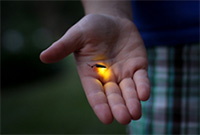
A glowing firefly sitting in a person's open palm. Firefly. Credit: Stock photo.

The yellow-green glow from this summer’s fireflies teased my kids across the yard. Max and Stella zigzagged the grass, occasionally jumping into the air to cup a firefly in their hands and then proudly shouting, “I got one!”

Chasing fireflies on a summer night is a childhood rite of passage for many, including Nathan Shaner who grew up in New Jersey. “It was one of my favorite things about summer,” he recalls. “I’d catch them with my hands—I’d never jar them.”

Today, Shaner studies the science of bioluminescence, which gives fireflies and many other organisms the natural ability to emit light. His goal is to make bright bioluminescent tags that he and other scientists can use to study living cells in greater detail. “There’s this very beautiful thing that evolved in nature, and we can use it to enable new discoveries,” he says.

Thousands of organisms glow as a way to communicate, spook predators, lure prey or attract mates. There are a few terrestrial examples, such as fireflies, glowworm insect larvae and foxfire fungi, and many more aquatic ones, including types of marine plankton, fish, jellyfish, shrimp, squid and sea urchins. One research team estimated nearly three quarters of sea life have bioluminescent capabilities.

Continue Reading

Archived: On Pi Day, Computational Biologists Share What They Love About Math

March 14, 2017
Another cool fact about Pi: The mirror reflection of the numbers 3 1 4 spells out P I E.

Why do math lovers around the world call March 14 “Pi Day”? Because Pi, the ratio of a circle’s circumference to its diameter, is 3.14. Pi is a Greek letter (π) that represents a constant in math: All circles have the same Pi, regardless of their size. Pi has been calculated out to as many as 1 trillion digits past the decimal, and it can continue forever without repetition or pattern.

In honor of Pi Day, we asked several biomedical researchers in the field of computational biology to tell us why they love math and how they use it in their research.

Continue Reading

Archived: Protein Paradox: Enrique De La Cruz Aims to Understand Actin

August 3, 2016
Enrique M. De La Cruz Credit: Jeff Foley, American Heart Association.
Enrique M. De La Cruz Grew up in: Newark and Kearny, New Jersey Job site: Yale University Favorite food: His mom’s Spanish-style polenta (harina de maíz) Alternative career: Managing a vinyl record shop Favorite song: “Do Anything You Wanna Do” by Eddie & The Hot Rods
Enrique De La Cruz stood off to the side in a packed room. As he waited for his turn to speak, he stroked the beads of a necklace. Was he nervous? Quietly praying? When he took center stage, the purpose of the strand became clear. Like a magician—and dressed all in black—De La Cruz held up the necklace with two hands so everyone, even those sitting in the back, could see it. It was made of snap-together beads. De La Cruz waved the strand. It wiggled in different directions. Then, with no sleight of hand, he popped off one of the beads. The necklace broke into two. For the next hour, De La Cruz pulled out one prop after another: a piece of rope from his pocket, a pencil tucked behind his ear and even a fresh spear of asparagus stuffed in his backpack. At one point, De La Cruz assembled a conga line with people in the front row.
Continue Reading

Archived: Viral Views: New Insights on Infection Strategies

May 25, 2016

The following images show a few ways in which cutting-edge research tools are giving us clearer views of viruses—and possible ways to disarm them. The examples, which highlight work involving HIV and the coronavirus, were funded in part by our Biomedical Technology Research Resources program.

Uncloaking HIV’s Camouflage

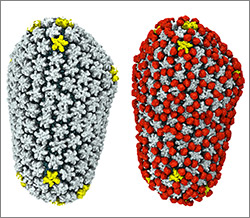
HIV capsid with (right, red) and without (left) a camouflaging human protein.
HIV capsid with (right, red) and without (left) a camouflaging human protein. Credit: Juan R. Perilla, Klaus Schulten and the Theoretical and Computational Biophysics Group, University of Illinois at Urbana-Champaign.

To sneak past our immune defenses and infect human cells, HIV uses a time-honored strategy—disguise. The virus’ genome is enclosed in a protein shell called a capsid (on left) that’s easily recognized and destroyed by the human immune system. To evade this fate, the chrysalis-shaped capsid cloaks itself with a human protein known as cyclophilin A (in red, on right). Camouflaged as human, the virus gains safe passage into and through a human cell to deposit its genetic material in the nucleus and start taking control of cellular machinery.

Biomedical and technical experts teamed up to generate these HIV models at near-atomic resolution. First, structural biologists at the Pittsburgh Center for HIV Protein Interactions used a technique called cryo-electron microscopy (cryo-EM) to get information on the shape of an HIV capsid as well as the capsid-forming proteins’ connections to each other and to cyclophilin A. Then experts at the Resource for Macromolecular Modeling and Bioinformatics fed the cryo-EM data into their visualization and simulation programs to computationally model the physical interactions among every single atom of the capsid and the cyclophilin A protein. The work revealed a previously unknown site where cyclophilin A binds to the capsid, offering new insights on the biology of HIV infection.

Continue Reading

Archived: Visualizing Skin Regeneration in Real Time

April 28, 2016
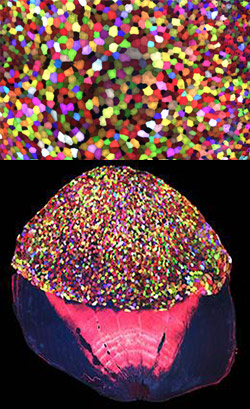
Top: Colorful skin cells on a zebrafish . Bottom: Cells from the outer surface of the scale.
More than 70 Skinbow colors distinguish hundreds of live cells from a tiny bit (0.0003348 square inches) of skin on the tail fin of an adult zebrafish. The bottom image shows the cells on the outer surface of a scale. Credit: Chen-Hui Chen, Duke University.

Zebrafish, blue-and-white-striped fish that are about 1.5 inches long, can regrow injured or lost fins. This feature makes the small fish a useful model organism for scientists who study tissue regeneration.

To better understand how zebrafish skin recovers after a scrape or amputation, researchers led by Kenneth Poss of Duke University tracked thousands of skin cells in real time. They found that lifespans of individual skin cells on the surface were 8 to 9 days on average and that the entire skin surface turned over in 20 days.

The scientists used an imaging technique they developed called “Skinbow,” which essentially shows the fish’s outer layer of skin cells in a spectrum of colors when viewed under a microscope. Skinbow is based on a technique created to study nerve cells in mice, another model organism.

The research team’s color-coded experiments revealed several unexpected cellular responses during tissue repair and replacement. The scientists plan to incorporate additional imaging techniques to generate an even more detailed picture of the tissue regeneration process.

The NIH director showcased the Skinbow technique and these images on his blog, writing: “You can see more than 70 detectable Skinbow colors that make individual cells as visually distinct from one another as jellybeans in a jar.”

This work was funded in part by NIH under grant R01GM074057.

Continue Reading

Archived: The Proteasome: The Cell’s Trash Processor in Action

April 22, 2016
Our cells are constantly removing and recycling molecular waste. On the occasion of Earth Day, we put together this narrated animation to show you one way cells process their trash. The video features the proteasome, a cellular machine that breaks down damaged or unwanted proteins into bits that the cell can re-use to make new proteins. For this reason, the proteasome is as much a recycling plant as it is a garbage disposal.

For more details about the proteasome and other cellular disposal systems, check out our article How Cells Take Out the Trash.
Continue Reading

Archived: Get Posts When They’re Published

April 21, 2016
GD SignupEver since the NIGMS Feedback Loop launched in 2005, we’ve sent periodic digests of its content to our grantees, applicants and others. To help our readers receive time-sensitive information sooner, we’re now offering a way to get individual posts as they’re published on the blog. If you’d like to receive new posts by email, go to our email updates page, enter your email address, click the Submit button and then check the box next to NIGMS Feedback Loop Blog on the Quick Subscribe page. Each time we add a post to the blog, you’ll get an email message with the first part of the post and a link to the full version. We average about 4 posts per month. For the time being, we’ll continue emailing the digests of recent posts. If you subscribe to receive individual posts and no longer want to get the periodic digests, you can cancel your digest subscription. You can also follow the blog via its RSS feed.
Continue Reading

Archived: The Importance of Your Input

February 3, 2016
This is the 500th Feedback Loop post. We’ve made numerous changes since the blog launched in 2009, but one of the things that’s stayed the same is the importance of your input. Your responses to our posts have given us valuable information and insights on our policies and plans. They've also helped us identify topics that interest you or that we could clarify. If there’s a topic you’d like us to write about—or if you have any other feedback for us—please leave your suggestions in the comment section below or email me.
Continue Reading

Archived: Recognition for CRISPR Gene-Editing Tool

December 17, 2015
The CRISPR gene-editing tool was recognized today by Science magazine as its “breakthrough of the year.” We support a number of researchers working in this exciting area and have featured it on this blog. To learn more about this exceptionally promising new method, see below for our illustrated explanation of the CRISPR system and its possible applications.
How the CRISPR System Works
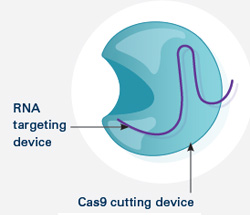
Illustration of CRISPR system
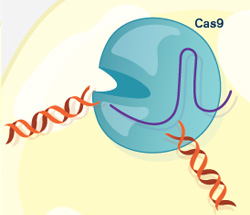
The CRISPR system has two components joined together: a finely tuned targeting device (a small strand of RNA programmed to look for a specific DNA sequence) and a strong cutting device (an enzyme called Cas9 that can cut through a double strand of DNA).

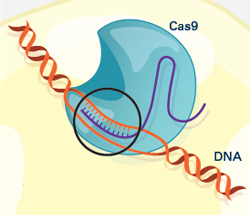
CRISPR system in a cell
Once inside a cell, the CRISPR system locates the DNA it is programmed to find. The CRISPR seeking device recognizes and binds to the target DNA (circled, black).

The Cas9 enzyme cuts both strands of the DNA.

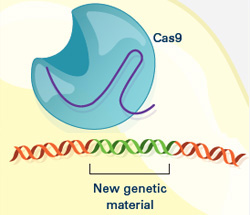
New genetic material incorporated into the broken DNA
Researchers can insert into the cell new sections of DNA. The cell automatically incorporates the new DNA into the gap when it repairs the broken DNA.

CRISPR has many possible uses, including:
  • Insert a new gene so the organism produces useful medicines.
  • Help treat genetic diseases.
  • Create tailor-made organisms to study human diseases.
  • Help produce replacements for damaged or diseased tissues and organs.
Continue Reading