Emily Carlson

Email
no43_email@nih.gov
First Name
Emily
Last Name
Carlson
machine_name
emily-carlson

Archived: Meet Maureen L. Mulvihill

February 9, 2015
Maureen L. Mulvihill, Ph.D. Fields: Materials science, logistics Works at: Actuated Medical, Inc., a small company that develops medical devices Second job (volunteer): Bellefonte YMCA Swim Team Parent Boost Club Treasurer Best skill: Listening to people Last thing she does every night: Reads to her 7- and 10-year-old children until “one of us falls asleep”
If you’re a fan of the reality TV show Shark Tank, you tune in to watch aspiring entrepreneurs present their ideas and try to get one of the investors to help develop and market the products. Afterward, you might start to think about what you could invent. Maureen L. Mulvihill has never watched the show, but she lives it every day. She is co-founder, president and CEO of Actuated Medical, Inc. (AMI), a Pennsylvania-based company that develops specialized medical devices. The devices include a system for unclogging feeding tubes, motors that assist MRI-related procedures and needles that gently draw blood. AMI’s products rely on the same motion-control technologies that allow a quartz watch to keep time, a microphone to project sound and even a telescope to focus on a distant object in a sky. In general, the devices are portable, affordable and unobtrusive, making them appealing to doctors and patients. Mulvihill, who’s trained in an area of engineering called materials science, says, “I’m really focused on how to translate technologies into ways that help people.”
Continue Reading

Archived: Untangling a Trending Topic

February 6, 2015
It’s not every day that we log into Facebook and Twitter to see conversations about denaturing proteins and the possibility of reducing biotechnology costs, but that changed last week when a story about “unboiling” eggs became a trending topic. Since NIGMS partially funded the research advance that led to the media scramble, we asked our scientific expert Jean Chin to tell us more about it. What’s the advance? Gregory Weiss of the University of California, Irvine, and his collaborators have designed a device that basically unties proteins that have been tangled together.
Continue Reading

Archived: Forecasting Infectious Disease Spread with Web Data

December 12, 2014
Just as you might turn to Twitter or Facebook for a pulse on what’s happening around you, researchers involved in an infectious disease computational modeling project are turning to anonymized social media and other publicly available Web data to improve their ability to forecast emerging outbreaks and develop tools that can help health officials as they respond. Mining Wikipedia Data
Screen shot of the Wikipedia site
Incorporating real-time, anonymized data from Wikipedia and other novel sources of information is aiding efforts to forecast and respond to emerging outbreaks. Credit: Stock image.
“When it comes to infectious disease forecasting, getting ahead of the curve is problematic because data from official public health sources is retrospective,” says Irene Eckstrand of the National Institutes of Health, which funds the project, called Models of Infectious Disease Agent Study (MIDAS). “Incorporating real-time, anonymized data from social media and other Web sources into disease modeling tools may be helpful, but it also presents challenges.” To help evaluate the Web’s potential for improving infectious disease forecasting efforts, MIDAS researcher Sara Del Valle of Los Alamos National Laboratory conducted proof-of-concept experiments involving data that Wikipedia releases hourly to any interested party. Del Valle’s research group built models based on the page view histories of disease-related Wikipedia pages in seven languages. The scientists tested the new models against their other models, which rely on official health data reported from countries using those languages. By comparing the outcomes of the different modeling approaches, the Los Alamos team concluded that the Wikipedia-based modeling results for flu and dengue fever performed better than those for other diseases.
Continue Reading

Archived: Field Focus: Asking Our Expert About Modeling Ebola

November 21, 2014
Irene Eckstrand
NIGMS’ Irene Eckstrand answers questions about modeling Ebola. Credit: National Institute of General Medical Sciences.
Ebola is the focus of many NIH-supported research efforts, from analyzing the genetics of virus samples to evaluating the safety and effectiveness of treatments and vaccines. Researchers involved in our Models of Infectious Disease Agent Study, or MIDAS, have been using computational methods to forecast the potential course of the outbreak and the impact of various intervention strategies. Wondering how their work is going, I recently asked our modeling expert Irene Eckstrand a few questions. How useful are the forecasts? Forecasts give us a range of possible outcomes. In addition to being a useful public health tool to prepare for an outbreak, they’re an important research tool to test assumptions about how a disease may spread. When we compare the predicted and actual outcomes, we can confirm assumptions, such as the groups of individuals who are more likely to spread the infection to others. Continually doing this helps refine the models and ensure that their forecasts are as accurate as possible. What are some of the challenges the modelers face?
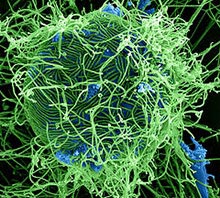
Ebola virus
Ebola virus particles (green) attached to and budding from a cell (blue). Credit: National Institute of Allergy and Infectious Diseases.
We need data to build and test models. The data available from this outbreak have been more limited than in most previous outbreaks of Ebola simply because the public health systems are overwhelmed with sick people, and recording information is a secondary priority. Another issue with forecasting future trends is incorporating information about the deployment of resources and the implementation of interventions that actually slowed the outbreak. We also need to incorporate changes in people’s behavior. If people think an outbreak is leveling off, they may relax the precautions they’ve been taking—and that could lead to another spike in the disease. What other Ebola-related projects are the MIDAS modelers working on? The MIDAS researchers are:
  • Modeling logistical factors such as the number and placement of treatment beds and staffing needs.
  • Tracking potential transmission within and between communities and at hospitals and funerals.
  • Developing a method to estimate the amount of underreporting of case data.
  • Applying models of “tipping points” to look for evidence that the disease curve is slowing.
  • Estimating the number of people who are infected but not symptomatic.
  • Creating new resources for Ebola modelers, including standards for using infectious disease data.
  • Calculating the risk of importation of cases for a wide variety of countries based on travel networks.
How are the modelers working together? The MIDAS modelers conference call 1-2 times a week to discuss results, modeling strategies, data sources and questions amenable to modeling. They also participate in discussions with government and other academic groups, so there’s a sizable number of modelers working on a wide variety of public health, logistical and basic research questions. If you’re interested in learning more about Ebola, Irene recommends a video overview of the 2014 outbreak from Penn State University Exit icon and a slide presentation on the myths and realities of the disease from Nigeria’s Kaduna State University Exit icon.
Continue Reading

Archived: 4 Timely Facts About Our Biological Clocks

October 31, 2014
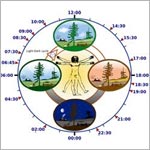
Illustration of circadian rhythm.
Genes and proteins run biological clocks that help keep daily rhythms in synch. Credit: Wikimedia Commons.
After you roll your clocks back by an hour this Sunday, you may feel tired. That's because our bodies—more specifically, our circadian rhythms—need a little time to adjust. These daily cycles are run by a network of tiny, coordinated biological clocks. NIGMS’ Mike Sesma tracks circadian rhythm research being conducted in labs across the country, and he shares a few timely details about our internal clocks: 1. They’re incredibly intricate. Biological clocks are composed of genes and proteins that operate in a feedback loop. Clock genes contain instructions for making clock proteins, whose levels rise and fall in a regular cyclic pattern. This pattern in turn regulates the activity of the genes. Many of the results from circadian rhythm research this year have uncovered more parts of the molecular machinery that fine-tune the clock. Earlier in the month, we blogged about an RNA molecule that cues the internal clock. 2. Every organism has them—from algae to zebras. Many of the clock genes and proteins are similar across species, allowing researchers to make important findings about human circadian processes by studying the clock components of organisms like fruit flies, bread mold and plants. 3. Whether we’re awake or asleep, our clocks keep ticking. While they might get temporarily thrown off by changes in light or temperature, our clocks usually can reset themselves. 4. Nearly everything about how our body works is tied to biological clocks. Our clocks influence alertness, hunger, metabolism, fertility, mood and other physiological conditions. For this reason, clock dysfunction is associated with various disorders, including insomnia, diabetes and depression. Even drug efficacy has been linked to our clocks: Studies have shown that some drugs might be more effective if given earlier in the day. Learn more: Circadian Rhythms Fact Sheet
Continue Reading

Archived: The Sweet Side of Chemistry

October 23, 2014
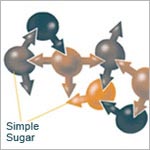
Glycans
Simple sugars connect in long, branched structures to create glycans. Credit: Stock image.
We’re in the middle of National Chemistry Week, which this year focuses on “The Sweet Side of Chemistry—Candy.” Studying sugar chemistry is also relevant to our health. The sugar in chocolate, taffy and other confections is a type of simple sugar called sucrose. In our bodies, sugars can exist in many forms, ranging from individual units like glucose to long, branched chains known as glycans containing thousands of individual sugar units linked together. Glycans are involved in just about every aspect of how our cells work. They help make sure proteins are folded into the proper shape so they function correctly. They act as ZIP codes that direct newly made proteins to the right cellular locations. Some divert white blood cells to infection sites, and others serve as anchors for viruses to latch onto. Because of the diverse and critical roles that glycans play in our bodies, chemists want to learn more about these molecules, with a long-term goal of harnessing them to treat or prevent disease. Read about some of their discoveries in the Why Sugars Might Surprise You article from Inside Life Science and the Life is Sweet article from Findings magazine. The You Are What You Eat chapter from ChemHealthWeb offers more details about the chemistry of sugar.
Continue Reading

Archived: Tune in for Video Resources on Navigating Peer Review, eRA Commons

October 7, 2014
The NIH Extramural Nexus blog has published posts on video resources that you may find helpful: New Webinars Connect Applicants to NIH Peer Review Experts: The Center for Scientific Review is hosting webinars in early November to give R01, R15, SBIR/STTR and fellowship grant applicants and others useful insights into the submission and review processes. Register by October 28. New Video Tutorials Can Help You Navigate eRA Commons: A 10-part series of short video tutorials walks you through the steps for submitting just-in-time information, a no-cost extension, a relinquishing statement and more. Watch the tutorials on the NIH Grants playlist on YouTube.
Continue Reading

Archived: Mighty Mitochondria

October 2, 2014
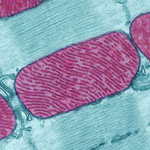
Mitochondria from the heart muscle cell of a rat.
Mitochondria (red) from the heart muscle cell of a rat. Nearly all our cells have these structures. Credit: Thomas Deerinck, National Center for Microscopy and Imaging Research.

Meet mitochondria: cellular compartments, or organelles, that are best known as the powerhouses that convert energy from the food we eat into energy that runs a range of biological processes.

As you can see in this close-up of mitochondria from a rat's heart muscle cell, the organelles have an inner membrane that folds in many places (and that appears here as striations). This folding vastly increases the surface area for energy production. Nearly all our cells have mitochondria, but cells with higher energy demands have more. For instance, a skin cell has just a few hundred, while the cell pictured here has about 5,000.

Scientists are discovering there's more to mitochondria than meets the eye, especially when it comes to understanding and treating disease.

Read more about mitochondria in this Inside Life Science article.

Continue Reading

Archived: A Crisper View of the CRISPR Gene-Editing Mechanism

September 22, 2014
To dismantle the viruses that infect them, bacteria have evolved an immune system that identifies invading viral DNA and signals for its destruction. This gene-editing system is called CRISPR, and it’s being harnessed as a tool for modifying human genes associated with disease. Taking another important step toward this potential application, researchers now know the structure of a key CRISPR component: a multi-subunit surveillance machine called Cascade that identifies the viral DNA. Shaped like a sea horse, Cascade is composed of 11 proteins and CRISPR-related RNA. A research team led by Blake Wiedenheft of Montana State University used X-ray crystallography and computational analysis to determine Cascade’s configuration. In a complementary study, Scott Bailey of Johns Hopkins University and his colleagues determined the structure of the complex bound to a viral DNA target. Like blueprints, these structural models help scientists understand how Cascade assembles into an efficient surveillance machine and, more broadly, how the CRISPR system functions and how to adapt it as a tool for basic and clinical research. Learn more: Montana State University News Release Exit icon Johns Hopkins University News Release Exit icon
Continue Reading

Archived: Intercepting Amyloid-Forming Proteins

August 19, 2014
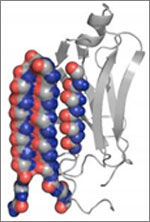
Structure of a protein involved in disease-associated amyloid fibrils.
A molecule targets the intermediary structure of a protein involved in disease-associated amyloid fibrils. Credit: University of Washington.
Alzheimer’s disease, type 2 diabetes and many other illnesses are linked to the buildup of proteins whose structures have changed into shapes that enable the formation of cell-entangling threads called amyloid fibrils. About 10 years ago, researchers led by Valerie Daggett of the University of Washington used computer simulations to suggest that such proteins, on their way to creating fibrils, form an intermediary structure called an alpha sheet that’s even more toxic to cells than fibrils. Now Daggett’s team has experimentally investigated this possibility. The scientists made alpha sheet molecules expected to bind to amyloid-forming proteins in the computationally predicted intermediate state. When they tested the molecules on two amyloid disease-related proteins, they observed a substantial reduction in fibril formation. The work is still very preliminary, but it highlights a potential new avenue for treating a range of amyloid-related diseases. This work also was funded by NIH’s National Institute of Allergy and Infectious Diseases. Learn more: University of Washington News Release Exit icon Daggett Lab Exit icon Monster Mash: Protein Folding Gone Wrong Article from Inside Life Science
Continue Reading