Emily Carlson

Email
no43_email@nih.gov
First Name
Emily
Last Name
Carlson
machine_name
emily-carlson

Archived: Resetting Our Clocks: New Details About How the Body Tells Time

March 6, 2014
VIP in time-keeping brain cells
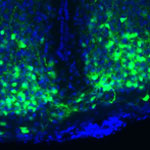
Boosting doses of a molecule called VIP (green) in time-keeping brain cells (blue) helped mice adjust quickly to major shifts in light-dark cycles. Credit: Cristina Mazuski in the lab of Erik Herzog, Washington University in St. Louis.
Springing clocks forward by an hour this Sunday, traveling across time zones, staring at a computer screen late at night or working the third shift are just a few examples of activities that can disrupt our daily, or circadian, rhythms. These roughly 24-hour cycles influence our physiology and behavior, and they’re driven by our body’s network of tiny timekeepers. If our daily routines fall out of sync with our body clocks, sleep, metabolic and other disorders can result. Researchers funded by the National Institutes of Health have spent decades piecing together the molecular mechanisms of our biological clocks. Now, they’re building on that basic knowledge to better understand the intricate relationship among these clocks, circadian rhythms and physiology—and ultimately, find ways to manipulate the moving parts to improve our modern-day lives. Continue reading this new Inside Life Science article
Continue Reading

Archived: Meet Ravi Iyengar

March 5, 2014
Ravi Iyengar
Ravi Iyengar Fields: Systems pharmacology and systems biology Works at: Mount Sinai School of Medicine, New York, NY Favorite sports team: Yankees Favorite subject in high school: Math Recently read book: The Signal and the Noise by Nate Silver Credit: Pedro Martinez, Systems Biology Center New York
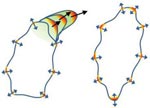
Ravi Iyengar, a professor at Mount Sinai School of Medicine, stood in an empty lecture hall, primed to tell thousands of students about systems biology, a holistic approach to studying fundamental life processes. To prepare for this moment, he had spent 4 months reading hundreds of scientific papers and distilling the research into understandable nuggets. But that day, his only student was a videographer. Together, they recorded 15 different lectures about systems biology—many related to Iyengar’s own research—that thousands of people would stream or download as part of a MOOC, or massive open online course. Trained in biochemistry, Iyengar built his research career around studying molecules and developing a list of all the parts that help nerve, kidney and skin cells to function. As he obtained more information, he realized he needed to know how all the components worked together. To achieve this comprehensive understanding, Iyengar turned to computational techniques and mathematical analyses—cornerstones of systems biology. For more than a decade, he has been using and developing systems biology approaches to explore a range of biomedical questions, from very basic to translational ones with immediate relevance to human health. Iyengar’s Findings In his earlier work, Iyengar used mathematical analyses to show that molecules within cells connect with one another to form switches that produce cellular memory. This may allow, for instance, an immune cell to remember a foreign object and secrete an antibody. In recent work, he and his team developed a mathematical model showing that the shape of a cell influences the flow of information across the membrane, possibly contributing to disease states and offering a way to study and identify them under the microscope. In another study, they analyzed a database of drug side effects to find combinations of medications that produce fewer adverse reactions and then created a cell biology interaction network that explains why a certain drug pair had this beneficial outcome. The approach could point to other combinations of FDA-approved drugs that reduce serious side effects and thereby guide clinical practice. “Systems biology is a powerful way to explore important biological and medical questions, and it’s relevant to many fields of science,” said Iyengar. But he added that the majority of educational institutions, including liberal arts and community colleges, don’t have systems biology courses. So, Iyengar teamed with colleagues to create a series of MOOCs. The first course, offered last summer and taught by Iyengar, presented all the facets of systems biology. The syllabus included lessons on genomics and bioinformatics, fields that have contributed to systems biology; gathering and integrating data; and the use of modeling in drug development. “My goal was for the students to get the general gestalt of systems biology,” explained Iyengar, who directs an NIH-funded center focused on the systems-level study of medicine and therapeutics. In total, more than 12,000 participants watched at least one video lecture, 3,000 submitted one or more of the weekly quizzes and 1,800 took a mid-term or final exam. The online discussions forum included nearly 400 topics with about 5,000 posts. The students, most enrolled in a graduate program or working full-time, had some training in the biological, biomedical, computer and information sciences. “The stats tell me that many people are in fields adjacent to systems biology and don’t have access to more traditional systems biology courses,” concluded Iyengar. “Through the MOOC, we can reach them in a substantial way.” The second course, which covers network analysis, wrapped up in early December, and the third course, which covers dynamical modeling methods, began in January. Iyengar plans to offer the intro course again in late March. Learn more: MOOC Systems Biology Courses Exit icon
Continue Reading

Archived: Local Flu Forecasts Posted on New Web Site

January 14, 2014
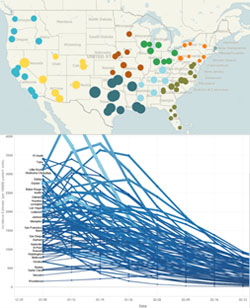
Incidence of influenza during the week starting 12/29/2013 (top); influenza incidence forecasts for selected cities (bottom). Credit: Columbia Prediction of Infectious Diseases.

News articles this weekend reported an uptick in flu cases in many parts of the country. When will your area be hardest hit? Infectious disease experts at Columbia University have launched an influenza forecast Web site that gives weekly predictions for rates of flu infection in 94 U.S. cities. The predictions indicate the number of cases in Chicago; Atlanta; Washington, D.C.; and Los Angeles will peak this week, with New York City, Boston, Miami and Providence peaking in following weeks. The forecasts are updated every Friday afternoon, so check back then for any changes.

The forecasting approach, which adapts techniques used in modern weather prediction, relies on real-time observational data of people with influenza-like illness, including those who actually tested positive for flu. The researchers have spent the last couple of years developing the forecasting system and testing it—first retrospectively predicting flu cases from 2003-2008 in New York City and then in real time during the 2012-2013 influenza season in 108 cities.

“People have become acclimated to understanding the capabilities and limitations of weather forecasts,” said Jeffrey Shaman, who’s led the flu forecasting project. “Making our forecasts available on the Web site will help people develop a similar familiarity and comfort.” Shaman and his team are hoping that, just as rainy forecasts prompt more people to carry umbrellas, an outlook for high influenza activity may motivate them to get vaccinated and practice other flu-prevention measures.

This work also was funded by NIH’s National Institute of Environmental Health Sciences.

Learn more:

Columbia University News Release

Continue Reading

Archived: NIH’s Sally Rockey on PubMed Comments, 2013 Success Rates, Lead Time for Inviting NIH Staff to Meetings

December 23, 2013
Within the last week, NIH’s Sally Rockey has published posts that may be of interest to you: PubMed Gets Interactive: The broader public now can view opinions and information shared by authors on scientific publications in PubMed. Application Success Rates Decline in 2013: An early analysis of 2013 competing research project grant applications and awards at NIH shows a downward trend for success rates. NOTE: We at NIGMS are currently working on our annual funding trends post. Understanding Lead-time for NIH Staff Participation in Scientific Meetings: Invitations for NIH program, review or other staff to speak at or attend a meeting need to be made as early as possible due to approval requirements and budget constraints. NOTE: Sally Rockey’s post suggests at least 4 months advance notice, but at NIGMS, we recommend at least 6 months.
Continue Reading

Archived: Detailing Key Structures of HIV

December 2, 2013
Structure of Env. Credit: The Scripps Research Institute.
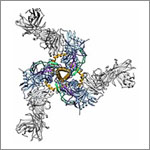
This model shows a birds-eye view of the structure of Env, a protein on the HIV surface that enables it to infect cells, bound to neutralizing antibodies. Credit: The Scripps Research Institute.
In a statement on World AIDS Day 2013, NIH leaders wrote, “In the 25 years that have passed since the first annual commemoration of World AIDS Day, extraordinary scientific progress has been made in the fight against HIV/AIDS. That progress has turned an HIV diagnosis from an almost-certain death sentence to what is now for many, a manageable medical condition and nearly normal lifespan. We have come far, yet not far enough.” One area of progress is in understanding the structural biology of HIV, the virus that causes AIDS. Capturing details about the virus’ shape has helped scientists better understand how HIV operates and pinpoint its Achilles' heels. Recently, scientists got a closer look at two key pieces of the virus. In one study, researchers developed the most detailed picture yet of Env, a three-segment protein on the HIV surface that allows the virus to infect cells. The work illuminated the complex process by which the protein assembles, undergoes radical shape changes during infection and interacts with neutralizing antibodies, which can block many strains of HIV from infecting human cells. The findings also may guide the development of HIV vaccines. In another study, researchers created the best image yet of the cocoon-like container, or capsid, that carries HIV’s genome. Capsids have been difficult to study because individual imaging techniques had not produced high enough detail. By combining several cutting-edge imaging methods, the scientists pieced together the individual polygonal units of the capsid like a jigsaw puzzle to determine its structure in detail. Now that they know how HIV’s inner vessel looks, the research team is searching for its cracks—potential targets for drug development.
Continue Reading

Archived: Cells Merrily ‘Row’ Without Sensor Proteins

November 18, 2013
Messenger proteins (left). When these proteins aren’t activated, the cell doesn’t move (right). Credit: Devreotes Lab, Johns Hopkins University School of Medicine.
Messenger proteins help the cell make large projections (left). When these proteins aren’t activated, the cell doesn’t move (right). Credit: Devreotes Lab, Johns Hopkins University School of Medicine. View larger image
A new study from Peter Devreotes Exit icon, Pablo Iglesias Exit icon and other scientists at Johns Hopkins University sheds light on the way in which cells get around the body to promote embryo development, wound healing and even cancer metastasis. Here’s how they describe cell movement and their findings: Think of the cell as a rowboat. Sensor proteins on the outside pass on directional signals to messenger proteins that serve as the cell’s coxswain. The coxswain then commands other members of the molecular crew to stay in sync, propelling the cell forward. If there are no sensor signals, the coxswain can still coordinate the cell’s movement, just not in any specific direction—it’s like a boat without a rudder. Scientists previously thought that the messenger proteins needed the sensor ones to produce both directional and random movements. Because defects in the messenger proteins have been linked to many types of cancer, the new work suggests these molecules could serve as a drug target for immobilizing tumor cells. Learn more: Johns Hopkins University School of Medicine News Release
Continue Reading

Archived: NIH Director Blogs About Value of Model Organisms in Drug Discovery Research

November 6, 2013
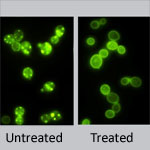
(Left) Untreated yeast cells, (Right) Treated yeast cells. Credit: Daniel Tardiff, Whitehead Institute.
Treating yeast cells with the NAB compound reverses the toxic effects of elevated levels of alpha synuclein protein. Credit: Daniel Tardiff, Whitehead Institute.
These eye-catching images and the NIGMS-funded research that yielded them were recently featured by NIH Director Francis Collins on his blog. Scientists led by a team at the Whitehead Institute for Biomedical Research engineered yeast to produce too much of a protein, alpha synuclein. In Parkinson’s disease, elevated levels or mutated forms of this protein wreak havoc on the cell. Using the model system, the researchers tested tens of thousands of compounds to identify any that reversed the toxic effects. One did. The compound, abbreviated NAB, worked similarly in an animal model and in rat neurons grown in a lab dish. Collins described the approach as “an innovative strategy for drug hunting that will likely be extended to other conditions.”
Continue Reading

Archived: Meet Emily Scott

November 5, 2013
Emily Scott
Emily Scott
Field: Biochemistry
Works at: University of Kansas in Lawrence
Favorite hobby: Scuba diving
Likes watching: “Law & Order”
Likes reading: True-life survival stories
Credit: Chuck France, University of Kansas

With an air tank strapped to her back, college student Emily Scott dove to the bottom of the Gulf of Mexico to examine life in an oxygen-starved area called the Dead Zone. The bottom waters had once teemed with red snapper, croaker and shrimp, but to Scott, the region appeared virtually devoid of life. Then, from out of the mud, appeared the long, undulating arms of a brittle star.

As Scott learned, that particular species of brittle star survived in the Dead Zone because it has something many other marine creatures don't: an oxygen-carrying protein called hemoglobin. This same protein makes our blood red. Key to hemoglobin’s special oxygen-related properties is a small molecular disk called a heme (pronounced HEEM).

Once she saw what it meant to brittle stars, Scott was hooked on heme and proteins that contain it.

Scott’s Findings

Now an associate professor, Scott studies a family of heme proteins called cytochromes P450 (CYP450s). These proteins are enzymes that facilitate many important reactions: They break down cholesterol, help process vitamins and play an important role in flushing foreign chemicals out of our systems.

To better understand CYP450s, Scott uses a combination of two techniques--X-ray crystallography and nuclear magnetic resonance spectroscopy—for capturing the enzymes’ structural and reactive properties.

She hopes to apply her work to design drugs that block certain CYP450 reactions linked with cancer. One target reaction, carried out by CYP2A13, converts a substance in tobacco into two cancer-causing molecules. Another target reaction is carried out by CYP17A1, an enzyme that helps the body produce steroid sex hormones but that, later in life, can fuel the uncontrolled growth of prostate or breast cancer cells.

"I'm fascinated by these proteins and figuring out how they work," Scott says. "It's like trying to put together a puzzle—a very addictive puzzle." Her drive to uncover the unknown and her willingness to apply new techniques have inspired the students in her lab to do the same.

Content adapted from "Hooked on Heme," an article in the September 2013 issue of Findings magazine.

Continue Reading

Archived: Protein Helps Chromosomes ‘Speed Date’ During Cell Division

October 28, 2013
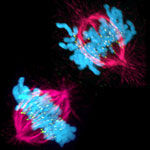
A cell in two stages of division: prometaphase (top) and metaphase (bottom). Credit: Lilian Kabeche, Dartmouth.
This image shows a cell in two stages of division: prometaphase (top) and metaphase (bottom). To form identical daughter cells, chromosome pairs (blue) separate via the attachment of microtubules made up of tubulin proteins (pink) to specialized structures on centromeres (green). Credit: Lilian Kabeche, Dartmouth.
Chromosome segregation during cell division is like speed dating, according to Geisel School of Medicine at Dartmouth researcher Duane Compton. He and postdoctoral fellow Lilian Kabeche learned that protein cyclin A plays moderator, helping to properly separate chromosomes via the attachment of microtubule fibers to kinetochore structures. Here’s how Compton described the process: “The chromosomes are testing the microtubules for compatibility—that is, looking for the right match—to make sure there are correct attachments and no errors. The old view of this process held that chromosomes and microtubules pair up individually to find the correct attachment, like conventional dating. However, our results show that the system is more like speed dating. All the chromosomes have to try many connections with microtubules in a short amount of time. Then they all make their final choices at the same time. Cyclin A acts like a timekeeper or referee to make sure no one makes bad connections prematurely.” Such bad connections can cause chromosome segregation errors that lead to cells with an abnormal number of chromosomes, a hallmark of cancer cells. So in addition to aiding our understanding of a fundamental biological process, the new insights may point to potential ways to correct such errors. Learn more: Dartmouth News Release Exit icon Compton Lab Exit icon
Continue Reading

Archived: NIH Director Blogs About NIGMS-Funded Research

September 6, 2013
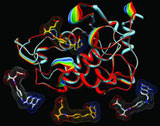
Antifolate drugs (bottom) work by blocking the folate receptor (top). Credit: Charles Dann III, Indiana University.
Caption: Antifolate drugs (bottom) work by blocking the folate receptor (top), starving cancer cells of an essential vitamin. Credit: Charles Dann III, Indiana University.

Within the last few weeks, NIH Director Francis Collins has blogged about several findings that NIGMS helped fund: the identification of a genetic link between hair color and melanoma risk and the solving of human folate receptor structures, which may aid the design of drugs for cancer and inflammatory diseases like rheumatoid arthritis and Crohn’s disease. Both advances are excellent examples of the value and impact of basic research. Want more examples? Check out Curiosity Creates Cures!

Continue Reading