Abbey Bigler-Coyne

Abbey Bigler

Abbey is a science writer who enjoys making important biological science and public health information accessible to everyone.

Filter by posts type:

Reset

Quiz: Are You a Genetics Genius?

May 19, 2021

Genes are segments of DNA. They contain instructions for building one or more molecules that help the body work. Researchers in the field of genetics study genes and heredity—how certain traits are passed from parents to their offspring through DNA. NIGMS supports many scientists who investigate the genetics of people and research organisms to better understand human health and disease.

Take our quiz below to test how much you know about genetics. For more quizzes and other fun learning tools, visit our activities and multimedia webpage.

Continue Reading

Science Snippet: Learn About the Cytoskeleton

May 12, 2021

The cytoskeleton is a collection of fibers that gives shape and support to cells, like the skeleton does for our bodies. It also allows movement within the cell and, in some cases, by the entire cell. Three different types of fibers make up the cytoskeleton: actin filaments, intermediate filaments, and microtubules.

Powering Muscles

Actin filaments contract or lengthen to give cells the flexibility to move and change shape. Along with the protein myosin, they’re responsible for muscle contraction, including voluntary movement and involuntary muscle contractions, such as our heartbeats. Actin filaments are the thinnest and most brittle of the cytoskeletal fibers, but they’re also the most versatile in terms of shape.

Continue Reading

Pumping Iron: The Heavy Lifting Iron Does in Our Bodies

May 5, 2021

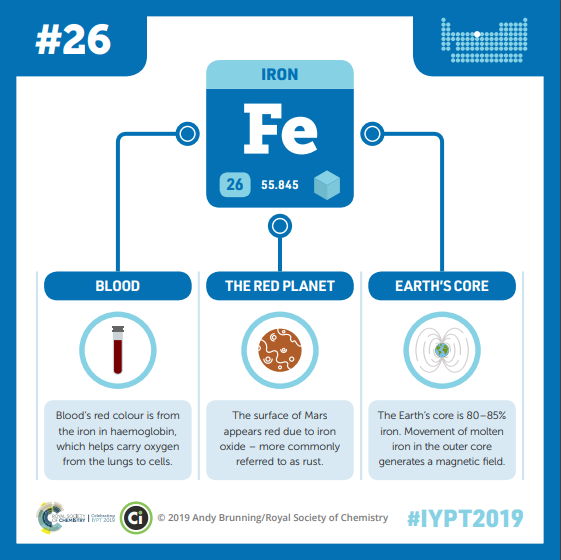
Our blood appears red for the same reason the planet Mars does: iron. The element may bring to mind cast-iron pans, wrought-iron fences, or ancient iron tools, but it’s also essential to life on Earth. All living organisms, from humans to bacteria, need iron. It’s crucial for many processes in the human body, including oxygen transport, muscle function, proper growth, cell health, and the production of several hormones.

A graphic showing iron’s abbreviation, atomic number, and atomic weight connected by lines to illustrations of a vial of blood, Mars, and Earth. Iron is the reason both our blood and the planet Mars appear red. The element also makes up the majority of Earth’s core and generates the planet’s magnetic field. Credit: Compound Interest. CC BY-NC-ND 4.0.
Continue Reading